
Bicester Rents Have Risen 34.8% Since 2021
Bicester's private rental market has changed considerably over the last five years. In 2021, the average monthly rent in Bicester was £1,126. So far in 2026, that figure stands at £1,518. That is a rise of 34.8%. To put that into context, the average UK rent increased from £1,390 in 2021 to £1,744 in 2026, a rise of 25.5%.
Tenants in Bicester are now paying substantially more than they were only five years ago. Affordability is now starting to matter more. Some landlords who have pushed rents too hard are finding the market less forgiving. Across the UK, 31% of rental listings have already seen asking rent adjustments in 2026, compared with 24% last year. That does not mean tenant demand has disappeared. It simply means tenants are becoming more price sensitive. In other words, the market is still strong, but it is not a blank cheque.
Bicester Rental Supply
Whilst rents have risen, the number of rental properties coming to the market in Bicester has not grown in the same way.
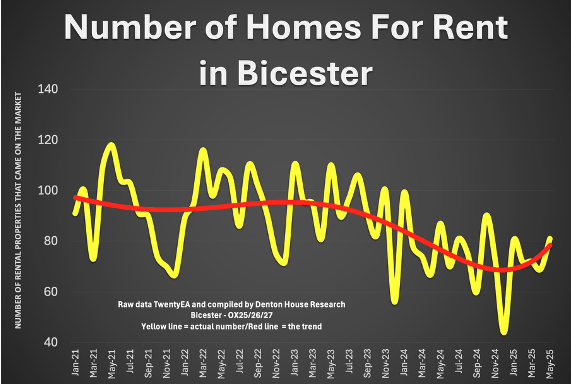
The average number of new rental listings per month in Bicester (OX25/26/27) was:
• 91 in 2021
• 96 in 2022
• 93 in 2023
• 75 in 2024
• 82 in 2025
• 79 in 2026 so far
Rental choice for tenants is still tight, and demand continues to absorb much of the available stock. Seasonality also plays its part. Nationally, rental supply tends to be strongest in late spring and early autumn, with October often being particularly active. Winter is usually quieter, especially December, when fewer landlords choose to bring properties to the market. That normal seasonal pattern was disrupted during the pandemic, but it has largely returned.
Demand Remains Strong, But the Frenzy Has Eased
The intense rental frenzy seen in parts of 2022 and 2023 has cooled slightly, but good homes still attract strong interest. Well-presented properties in sensible locations continue to generate multiple enquiries, particularly because Bicester remains relatively affordable compared with many nearby towns and cities.
That affordability is one of Bicester's strengths.
For tenants, it offers value. For landlords, it helps maintain demand. For the rental market as a whole, it creates resilience.
Nationally, rental availability remains more than 25% below pre-pandemic levels. Analysts estimate that around 50,000 additional rental homes are needed each year across the UK to restore availability to where it was before 2020. Until that supply gap closes, upward pressure on rents in towns like Bicester is likely to continue.
That said, I do not expect rental growth to continue at the same pace as we saw in the immediate post-pandemic period. The market is still moving upwards, but the rate of growth is likely to moderate. For 2026, I would expect Bicester rents to rise by a further 2% to 3% in this calendar year, assuming tenant demand remains strong and supply does not increase significantly.
Challenges and Opportunities for Bicester Landlords
For Bicester landlords, the private rented sector remains a market of two halves.
On one side, rents remain robust, tenant demand is healthy, and well-presented homes continue to let quickly. On the other, landlords face increasing regulation, rising costs, and a tax environment that is considerably less favourable than it was a decade ago. The key question is not whether buy-to-let still works in Bicester, it is whether landlords are willing to adapt to a changing landscape.
Challenges for Bicester Landlords
Rising Costs Continue to Eat Into Profits
Many landlords have seen financing costs rise significantly in recent years. Although interest rates have eased from their peak, borrowing remains considerably more expensive than it was in the years following the pandemic.
At the same time, inflation has pushed up the cost of repairs, maintenance, insurance and compliance. For many landlords, around a fifth of rental income can now disappear on ongoing upkeep before mortgage costs are even considered.
Greater Tenant Expectations
Today's tenants expect more from their homes than ever before. Energy efficiency, fast broadband, modern kitchens and attractive living spaces have become increasingly important.
Landlords also need to balance rental growth with affordability. While rents have risen strongly, long term tenant retention is often more profitable than chasing every last pound of rental income. With ongoing cost of living pressures, keeping good tenants happy has become an important part of successful portfolio management.
Taxation and Administration
Successive tax changes have reduced profitability for many landlords in the last few years. Restrictions on mortgage interest relief (section 24), changes to Capital Gains Tax allowances and the growing administrative burden of compliance have all increased costs. Making Tax Digital and other reporting requirements are adding further complexity for portfolio landlords.
These pressures did contribute to some BTL landlords leaving the sector altogether in the last few years. Yet TwentyEA data shows that in Q1 2026, only just over 1 in 8 (12.8%) of UK homes coming onto the market had previously been rental properties, compared to nearly 1 in 4 (22.5%) only a year earlier, meaning the exodus has dropped and returned to long term levels.
Legislation and Compliance
The regulatory landscape continues to evolve, especially with the Renters Rights Act coming into force a matter of a few weeks ago. Also, ongoing discussions around minimum energy efficiency standards have left many landlords uncertain about future obligations and costs. For owners of older Bicester BTL housing stock in particular, future compliance requirements could require significant investment over the coming years.
Opportunities for Bicester Landlords
Whilst some Bicester landlords are selling up, plenty of others are taking advantage of the opportunity and buying more BTL homes. In fact, 211,700 UK homes were bought as BTL investments in the last financial year even with the increase in stamp duty.
Strong Tenant Demand
Bicester continues to benefit from a healthy tenant base. Its relative affordability, good transport links and broad mix of housing attract a wide range of renters, from young professionals and families through to downsizers and retirees. Well-presented homes in desirable locations in the town often attract strong interest and experience minimal void periods.
Improving Rental Returns
Rental growth over recent years has pushed yields to some of the strongest levels seen for over a decade. For Bicester landlords with little or no borrowing, much of this rental growth flows directly to the bottom line. Even leveraged investors can still achieve attractive returns where rents have kept pace with financing costs.
The Bottom Line
The Bicester rental market is undoubtedly more demanding than it was ten or twenty years ago. Yet it remains a market full of opportunity for landlords who are prepared to run their investments professionally, maintain their properties to a high standard, and adapt to changing tenant expectations.
The easy money may have gone, but there is still good money to be made.
Whether you self-manage your Bicester BTL properties or use another letting agent in the town, I am always happy to share my thoughts on the local rental market and discuss the strategies that seem to be working best in today's market.
And for everyone else, what do you think? Have I missed anything important?