
Why is Blackwater Property Market Bucking the National Trend?
There is a growing shift taking place in the UK property market, and it is not one that can be ignored. While much of the national conversation focuses on house prices and interest rates, a quieter yet more revealing metric is beginning to stand out, how long properties are taking to sell.
This first can be seen in how long properties are taking to sell. Nationally, the average UK home is taking 77 days to sell. In the Berkshire area, this is slightly higher, yet the average Blackwater home is taking 53 days to sell.
When we dive deeper, nationally around 1 in 3 homes in the UK have been on the market more than 12 weeks.
Yet at the time of writing, of the 64 homes for sale in Blackwater, 3 have been on the market for more than 12 weeks, equating to 4.2% of all available properties or around 1 in 20. This means Blackwater is bucking the national trend.
So, Blackwater is booming?
Yes, and ….. no
Over the last 12 months, for all agents in Blackwater combined, just 58.1% of homes that left estate agents’ books, did the homeowner move. The remaining 41.9% Blackwater homes withdrew from the market, unsold.
All stats point to something significant, a property market where timing is becoming just as important as pricing.
Everybody knows the first few weeks of a property coming to market have always been the most critical. This initial launch period is when a home is fresh to the market, attracting the highest levels of attention from motivated buyers. When a property is priced correctly and presented well, it is during this window that it is most likely to secure a buyer.
Yet, there is now some recent research from our friends at Denton House Research who analysed last year’s 900k+ UK sales agreed. Below, you can see the spread of sales and how they drop off as time goes by ...
· Week 1 - 8.0% (of all houses sales in the UK take place in the first week)
· Week 2 - 14.2%
· Week 3 - 11.4%
· Week 4 - 8.2%
· Week 5 - 6.4%
· Week 6 - 5.2%
· Week 7 - 4.4%
· Week 8 - 3.9%
By week 16, that has reduced to 1.5% of sales and by week 26, that is down to 0.6%
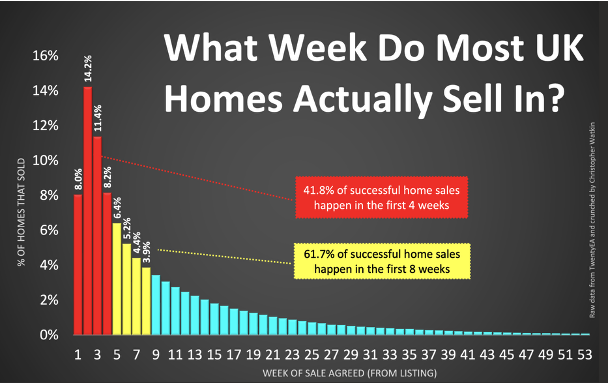
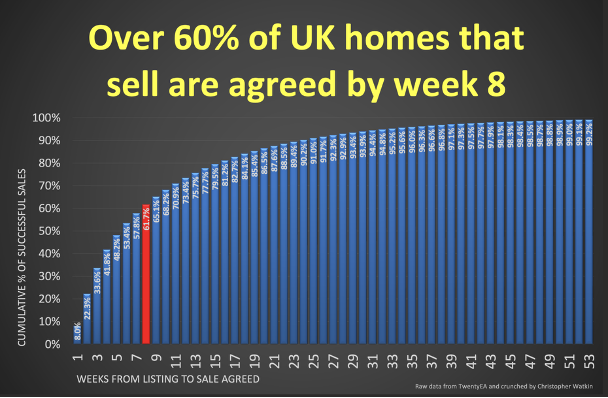
41.8% of all UK house sales take place in the first 4 weeks of the home being marketed and that rises to 61.7% of sales within 8 weeks. If you get to week 12 unsold, you only have a 14.5% chance of selling your home.
Also, the quicker you achieve a sale agreed on your home, the greater the chance you will end up moving home. Homes that find a buyer within the first 25 days of it marketing have around a 19 out of 20 (94%) chance of that sale going on to exchange and complete (i.e., you move home). If a sale is agreed after 100 days, the chances of that sale reaching exchange and completion plummet down to 11 out of 20 (56%).
The challenge arises when that initial window is missed. Once a property has been on the market for several months, buyer perception begins to shift. Rather than being seen as a new opportunity, it risks being viewed as a home which has something ‘wrong with it’. Prospective buyers start to question why it has not sold and, in many cases, assume there must be an underlying issue, whether justified or not.
This is where time on the market becomes more than just a statistic. It begins to influence the outcome.
A common factor behind extended marketing periods is overpricing at the point of launch.
Many sellers are advised, or choose, to test the market at a higher figure, with the expectation that adjustments can be made later if needed. While this approach may appear to be the best approach, it often has the opposite effect. That’s not to say that you can’t ‘test the market’, but you must do that within a very short period of no more than a couple of weeks. If you haven’t achieved the sale or any serious interest in those few weeks, that is the time to take the asking price down. If you delay a price reduction until week 8 or beyond, the property has already been exposed to the most active segment of buyers, and the opportunity to generate strong early interest has passed. Instead of ‘testing the market’, you have ‘tested the market’s patience’ and it has moved on.
In this context, pricing is not simply about achieving the highest possible figure. It is about positioning a property correctly from the outset to attract the right level of demand.
This discussion also brings into focus the role of sole agency agreements, particularly those extending to 20 or 26 weeks. Many ‘larger’ estate agents advocate longer tie in periods, arguing that they provide the time needed to secure the best possible result. However, this data, when viewed alongside buyer behaviour and time to secure a sale, raises valid questions. Long sole agency agreements are there to protect the agent, not you as the owner.
It is not a single, uniform market, but a collection of micro markets operating simultaneously. Different streets, property types, and price brackets can all behave very differently, even within the same town. What remains consistent, however, is the relationship between time and success. Properties that are correctly priced from day one are far more likely to achieve early interest, secure a buyer, and progress to completion. Those that miss that window often face a more challenging journey.
For homeowners in Blackwater, whether currently on the market or considering a move, the message is clear. Time on the market is not just a reflection of what has happened. It is a leading indicator of what is likely to happen next. And in a national property market where only around half of homes successfully sell (53.5% to be exact), that is a detail worth paying close attention to.